Showing posts with label Charlotte Mason. Show all posts

04 August, 2015

Working on Recitation for an end-of-term program for parents


I wanted to share a few photos and brief descriptions of one of my classes in 
Poetry Recitation for an end of year program 


Rehearsal 


Performance day


For this performance, from a later term, the class chose "The Retired Cat" by
William Cowper


We staged a bit of a skit for the recitation of this one. 


Take time to memorize some poetry!
 It will stay with you - very likely sink down deep into your soul - for a very long time.


Javamom

01 August, 2015

Putting on Shakespeare Plays ~ CM Education

These photos are a couple of years or more old, but...
I want to affirm that both younger and older students can handle reading and performing Shakespeare. They just need to be given the permission of plenty of time to read it (in a class setting is more fun!) and narrate it over a term or two! Here are just a few examples from rehearsals for various Shakespeare plays in our CM co-op! I wanted to put these in one post, for easier reference.

Our Narrators ~ "All the world's a stage!"


Orlando (my son) and Oliver


Celia and Rosalind aka Ganymede


Orlando and Oliver in "As You Like It"


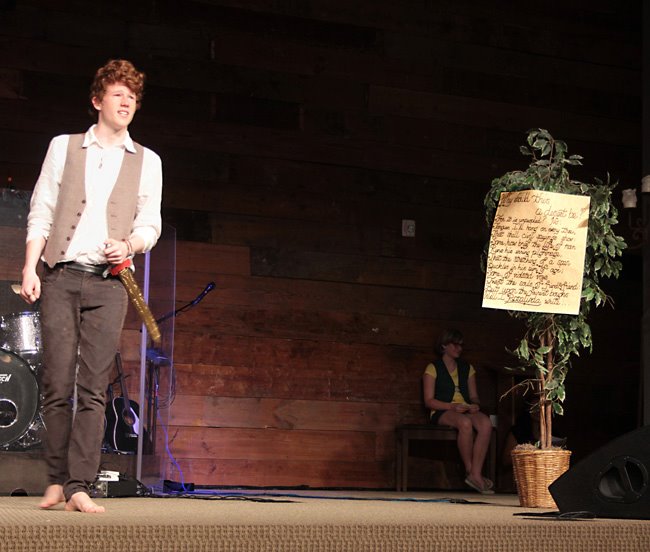
Orlando (my son :-) and his love letter from Rosalind


~ HAMLET ~


Hamlet and Laertes


Very intense moment between Hamlet and Laertes (and excellent acting by our cast)


The younger students are rehearsing for "The Tempest"


and they are doing a knock-out job


Do not be afraid to give Shakespeare a try with a few friends! Our group (the youngers) even performed for us in the backyard of one of our family's homes for an end-of-year picnic.

Take time to try some Shakespeare!

Javamom

21 April, 2011

To a Child Born in April

Two of our four children were born in April, our married daughter and our youngest son, who is turning 16.

My husband, my mother, and sister, brother and my late Granny, and several nieces and nephews, also have April birthdays. We love April! This poem is for them (replace maid and lassie with 'Lad' for the boys ;-)


To a Child Born in April

by K.E.W.
Parents' Review magazine, 1893-94
vol. 4 pg. 361

Happy little April maid
Who in early childhood played,
In the father-tended glade,
All among the flowers!

Happy that thy mother's heart
Knows so well it's mother's part,
To be glad, for glad thou art
Babe of April joys.

Never mind the April showers
The will bring us lovely flowers;
God sends beauty, it is ours.
Wreathe thy happy brows!

Every little leaf and bud
Cowslip field and primrose wood
All for thee, to do thee good,
Skip then with the lambs!

Sing sweet April lassie sing
Thou art part of a joyous spring
Earth is thine, and Christ thy king
Praise him with the birds.

03 January, 2011

CM friends Christmas Gathering

I'm finally able to sit and resize photos from before the Christmas holiday. I've been anxious to get these uploaded to add to my collection from previous years. I appreciate the ladies in my book club so much. We always have interesting discussions of Charlotte Mason's books, but we also are a group that is big on encouraging each other in Motherhood.


1/5 of our usual bookclub attendance ~ some years are just so busy for everyone, and some were recovering from illness or surgery. Some have children in city choirs and had their Christmas concert that night!


Here we took a breath and relaxed for a second pose.


This is the book mark that I made to give this year. I have always made them in warm colors in the past. This year, I had some blue book cloth leftover that was too small for a book repair. Viola...perfect size for a bookmark!


Lori, whose home we've been blessed to meet in for the last six months.


Deven


Krista, who chose the number (in our gift exchange) that corresponded with this lovely journal book and bookmark.


Kim W


and here I am, reading aloud, as I love to do!


This is the bookmark that I scored! It is laminated in hard plastic, which is very handy.


Don't you just love these? I think CM bookclubs should spring up all over the country, and members should make bookmarks with favorite Charlotte educational or parenting quotes!


That is your challenge, dear reader, for the New Year, should you choose to accept it!
It is enriching, meeting these kindred spirits and new-to-lifelong learning moms. Even moreso than meeting them and sharing online. :-)


Lets just call it an added bonus, shall we?


Javamom

09 March, 2009

The Dreaded Subject of Math(!)

In my last post, I mentioned Gesturing and some research that indicates how it helps engage students in learning and memory retention. It does this by using a different part of the brain, and I'm thinking that engaging extra parts of the brain, other than simply short-term memory, has to be better, right? Research would tell us unequivocally and enthusiastically, yes!

I have sat on the following information for a couple of years, now, and have not shared them here, simply because I spent my time focusing on and prepping my Foreign Language philosophy and lesson plans. Now it has become more important to me to focus on a holistic approach to math, as our youngest needs something more tangible to continue his journey (read: "in order to have some successes in math as he enters high school").

Hopefully, you will be able to find useful ideas in the following articles, from James J. Asher of the Total Physical Response approach to learning. My friend Katie noted (through a FaceBook chat) when I shared one of Asher's articles, titled "The Myth of Algebra," he goes straight to "Living Math" just like Charlotte Mason recommended in her educational philosophy and writing back in the late 19th-early 20th centuries.

The first article, "Fear of Math," may describe one of your own children...or may describe you yourself. I relate to the disability completely! As evidence of this fact, you will notice that before this day, there was not one post in almost 4.5 years of blogging where I wrote about or labeled a post under any "Math" category.

The next few articles I'll share are:

"Some Mysteries of Arithmetic Explained: Secrets revealed that may help parents and teachers clarify mathematics for youngsters."

"Why students of all ages are failing mathematics and what can be done to turn it around"

and

"Learning Algebra on the Right Side of the Brain"


Now, that's plenty of "homework" for you to read, so take your time. Next, get back to me with your thoughts, observations, and what action you are prompted to take with your own children, if you decide to change anything at all.

For specific ideas and lesson plans to put this philosophy of "Living Math" to good use, visit this Living Math web site.


Ciao for now!

Javamom

16 November, 2008

Upon Reading

"It is only those who have read who do read."

Isn't that obvious? I chuckled a bit when I read this.

Charlotte Mason says this reflecting upon Sir Philip Magnus' conception; who emphasized the importance of the 'habit of reading' as a chief acquirement of school life.'

I should post more from these last two chapters that I am leading my CM book club through. It is in this chapter, chapter 21 of volume 3 _School Education_, where she is in the midst of outlining a detailed scope of a curriculum based upon her educational principles.

But first, I must be off to pick up our fourth teen from his youth group small group.


Any reflections on this quote that you'd like to share with me? Be my guest!!


Javamom

28 August, 2008

"Beyond Narration, Then What?"

I promised you all that I would post some exciting notes from my last Charlotte Mason bookclub meeting. The reason it is exciting is because these are important details that have been overlooked or oversimplified too often over the decades, among too many folks who have talked or written about a CM education. That's sad, because then other hs moms miss out, perhaps thinking that CM is only for younger children in the early years, or that CM is too "child led" or even worse, they categorize CM as "Christian Unschooling," which couldn't be further from truth. I received questions based on some of these myths two or three times in the last week alone, and from people unrelated to my book club.

So, from Volume 3 Chapter 16, I share important notes ~

This volume focuses on children in what we call the "middle grades" around age 12. In her preface, Charlotte says that this volume contains suggestions for a curriculum for children under 12, but in the appendices, she includes samples from lessons and exams from ages 8 to age 16.5.


Did you notice what Charlotte said to do after a careful, one-time reading and narration of a book of high literary quality?


"But this is only one way to use books: others are to:

1) enumerate the statements
2) to analyse a chapter
3) to divide it into paragraphs under proper headings
4) to tabulate and classify series
5) to trace cause to consequence and consequence to cause
6) to discern character and perceive how character and circumstance interact
7) to get lessons of life and conduct

the living knowledge which makes for science, out of books


...all this is possible for school boys and girls, and until they have begun to use books for themselves in such ways, they can hardly be said to have begun their education."

Wow! That is rich and important!

This next bit, I do in my Spanish classes, and would do well to do it more consistently for my own children and HEO material, even though they become more independent in the older years:

Vol 3 pg 180-81

"The teacher's part is, in the first place, to see what is to be done, to look over the of the day in advance and see what mental discipline, as well as what vital knowledge, this and that lesson afford; and then to set such questions and such tasks as shall give full scope to his pupils' mental activity.

1) Let marginal notes be freely made, as neatly and beautifully as may be, for books should be handled with reverence.

2) Let numbers, letters, underlining be used to help the eye and to save the needless fag (fatigue) of writing abstracts.

3) Let the pupil write for himself half a dozen questions which cover the passage studied; he need not write the answers if he be taught that the mind can know nothing but what it can produce in the form of an answer to a question put by the mind to itself."


And then she closes chapter 16 with her caution regarding these devices or steps to help us learn the material from a good book:

"but let us be careful that our disciplinary devices, and our mechanical devices to secure and tabulate the substance of knowledge, do not come between the children and that which is the soul of the book, the living thought it contains."

One thing at the heart of her philosophy is that children should dig for the ideas from high quality books on their own, and also be encouraged by someone (another passionate author, or a teacher or parent) with passion enough for that knowledge that she gained from the original idea...so that now she shares it with enthusiasm with others. She believed the above thought so strongly, that we shouldn't let any of the tools or specifics on HOW to learn get in the way of WHAT we learn, see?

That is so important!! We will relate to information, ideas and remember things that resonate deeply in our souls more deeply than those random, and maybe even impressive facts that we memorize.


Comments, thoughts? What do you all do? Are you surprised by this revelation, that CM cared about writing, taking notes, and composition? She basically is saying, "make an outline" without spelling it out in those words, but also, analyze, compare, contrast, organize, check out the character and conduct, cause and effect, etc.

Nowadays, we have "post-it-note" tags and all, so we don't have to do as much marking in the margins, but I still do. I number points and highlight important things to share. Even for my book club. You should see my CM volumes all marked up...only the paperback ones. Any hardback volumes are left intact and unmarked. I mark up my Spanish Bible, too.

Textbook and classical folks really don't have an advantage over CM. But that may simply be my own personal observation, understanding, and opinion.


Javamom

09 February, 2008

The Family and Learning Languages

I wanted to share something I stumbled upon while reading some of the writings of Charlotte Mason today. I am a big believer in the power of the family (for better and for worse in some cases!) as the microcosm of training and prep toward larger society; how we function within our family(ies) and how I believe it is the primary training ground for our children and how they will approach larger life outside of the home as they grow older and engage with society more and more and eventually strike out on their own. I hope to provide for our own kiddos the sensitivity and understanding toward being loving, citizens of the world. Please don't make any assumptions of my politics based on those words, which tend (unfairly) to be loaded in the rhetoric of our political and religious evangelical landscape in which we find ourselves. What I mean is that they will be Christ to ALL others and not just be America-centric.

Anyway...I found this ~

Upon discussing the different ways in which the family unit is the unit of the nation, Charlotte Mason states in Volume 2, Parents and Children, pg. 7 the following:

"Let us ask the question: Has this, of regarding all education and all civil and social relations from the standpoint of the family any practical outcome? So much so, that perhaps there is hardly a problem of life for which it does not contain the solution. For example, what shall we teach our children? Is there one subject that claims our attention more than another? Yes, there is a subject or class of subjects which has an imperative moral claim upon us. It is the duty of the nation to maintain relations of brotherly kindness with other nations; therefore, it is the duty of every family, as an integral part of the nation, to be able to hold brotherly speech with the families of other nations as opportunities arise; therefore to acquire the speech of neighboring nations is not only to secure an inlet of knowledge and a means of culture, but is a duty of that higher morality (the morality of the family) which aims at universal brotherhood. Therefore, every family would do well to cultivate two languages besides the mother tongue, in the nursery.

Again; a fair young Englishwoman was staying with her mother at a German Kurhaus. They were the only English people present, and probably forgot that the Germans are better linguists than we. The young lady sat through the long meals with her book, hardly interrupting her reading to eat, and addressing no more than one or two remarks to her mother, as

(pg 8)

'I wonder what that mess is!' or, 'How much longer shall we have to sit with these tiresome people?' Had she remembered that no family can live to itself, that she and her mother represented England, were England for that little German community, she would have imitated the courteous greetings which the German ladies bestowed on their neighbours."


What do you all do about this dilemma? Have you ever traveled to another country and noticed or been saddened or embarrassed by your fellow countrymen at how they behaved in public in someone else's country, totally ignoring the cultural differences and acceptable mores within the given society in which they were visiting?


Javamom

11 December, 2007

CM book club party - Mothers work wonders :-)


My local Charlotte Mason friends have joined me to read CM's volumes 1 and 6 together, among other books written about CM and her methods over the past five or more years. We finished Volume One last month so we had a "CM quote bookmark exchange" and Christmas party for our December meeting. We even got a little spontaneous and called our missing CM mom friend, the Queen Bee, to serenade her for her birthday! We are not too wild, but we do know how to have a good time discussing Charlotte and encouraging each other along the way. Most of us in the group use Ambleside Online or HEO in our homes, some are new to CM. It's a neat mix of moms!

Not all my pictures came out so well, so a few moms are missing from the photos. We average about 10 moms per meeting, but have been known to have twenty attend some months! These ladies have become a really good support system, more micro-focused than just our regular hs support group. It has been really incredible to study with and even share in some homeschooling with some of these moms! I know that I am blessed! These moms literally drive from four corners of suburbs or cities in our metro area to join in the study and fellowship each month.


"Mothers work wonders once they are convinced that wonders are demanded of them."
~ C. Mason


"All beautiful and noble possibilities are present in everyone."


"I am, I can, I ought, I will." (framed above and on the bookmark below)


I don't remember what this one says, but isn't this creative? This one wins my vote for the clever award...it doubles as an ornament!


"And the only vital method of education appears to be that children should read worthy books, many worthy books."


The mom who made the above bookmark is expecting another child soon, so is very busy these days! She was not supposed to make one of these, but look how beautiful and detailed this is! You can't tell from the angle, but it has glitter on some sections, and it just sparkles when the light hits it.


"We are educated by our intimacies."


"The teacher who allows his scholars the freedom of the city of books is at liberty to be their guide, philosopher and friend; and is no longer the mere instrument of forcible intellectual feeding." (this is the one I made)


Mother Auma took this one. I had not opened my present, yet at this point. Mine was made by Señora Smith and is in the second photo at the top of this post.

Merry Christmas, friends and fellow CM families! Enjoy this special season with family and friends.

Javamom

22 October, 2007

My CM and TPR plan - Spanish

I moved this post to be at the top of my line-up, in hopes that it gets more notice, for those who've e-mailed me privately to ask for guidance. This is based on my research of Charlotte Mason's recommendations and on the Total Physical Response (James J. Asher) and TPR Storytelling (Blaine Ray) methods, which so far seem to be 90-95% identical to CM's recommendations. If I go back to school to get a Masters Degree, this is a subject in which I will dig into and research more deeply. I have several ideas for further study written in rough draft form, and will wait for the Lord's hand if this is to work out.

With my own younger two boys (ages 12 and 14) and with some of my AO students (children of my friends in my CM book club) I use the following procedures and resources. I will be fine-tuning these for the various capabilities of each age student that I teach (from ages 5-18), both at home and a little more traditional for high school in a homeschool co-op setting).

~ I use simple commands in the target language, in our case, Spanish. This is how children learn as babies and toddlers. For example: "Watch out! Look! Come to me! Bring me the plate! Sit down! Come here! Let's go! Don't run!" In Spanish this would sound (and look) a bit like this:

As recommended in TPR, I perform actions or gestures to express these, which works out great, because I talk with my hands, anyway!

¡Cuidado! - Be careful
Ven conmigo - come with me
Ven - Come
¡Venga aquí! - come here!
¡vamos! - Come along!
¡vamanos! - let's (all) go!
vamos a ver - Let's see!
vamos a leer - let's read!
Tráigame el plato; los platos -bring me the plate/plates
¡siéntete (por favor)! - (you-familiar) sit down (please)!
levántete por favor - (you-familiar) please stand up
¡escuche! - Listen!
escuchemos - let's listen
¡mira! - look/ look out!


¡No corre! - Don't run!
salta
- jump
toca - touch (as in toca el pelo-touch [the] hair. toca la boca touch [the] mouth)

So in a group I will say:

levanten la mano - (all of you-plural) raise the hand
bajen la mano - (all of you-plural) lower the hand

Abran sus libros a la página... - (all of you-plural) open your books to page...


~ Then I may add in phrases such as:
jump or stand on the chair, beside the chair, around the chair, etc.
~ Play "Simón dice" (Simon Says) with them. Play Bingo to reinforce numbers. Make up memory games with pictures. Vocabulary/Picture learning is recommended in the very young years, but especially pictures without words, only oral presentation of the words.
~ Later, make or purchase an inexpensive memory game in Spanish and English. I have one put out by Leap Frog that I found at Wal-Mart for 5 or 8 dollars. Sing your favorite songs in Spanish, whether they be children's songs, Bible verse songs, worship songs, hymns, or folk songs from Cuba. I am slowly building up my supply, and plan to keep posting updates to my blog. Say little poems aloud; the sing-song type poems or rhymes. I found a book of Traditional Spanish Rhymes just for this purpose. It has great illustrations, too. Find the living books listed in the early years of Ambleside Online in Spanish, then do a search for them at Amazon.com or do an online search for "libros en español," and click on the "juvenile" section. Their are a lot of adorable picture books that we are most familiar with available in Spanish, as well. Think of books such as "Buenas Noches Luna" and "Courduroy," "Frog and Toad," "Go Dog, Go!" and many others.

Here are two fun books I found a couple of months ago. These can be used as reference for CM words for the teacher/mom who hasn't had much or any Spanish. I posted links last week to audio-file pronunciation sites for phonetic help.


(The above photo is for Donna-Jean :-)


There are many free e-texts online in Spanish. Just do a search for "free e-texts" and "libros en español" to see what you come up with. Look for Stories such as "The Three Little Pigs" en español or "Little Red Riding Hood." I have posted some links to the blog already, but by the time I would be able to post 20 links of AO books here, you may well be able to find them on your own. I will post some in future as I am able! Stay tuned!

~ One important thing to do is to find traditional stories, fables and folk songs that are common to Spanish Speaking countries. Right now, I'm trying to have the balance of about 50% of stories/songs/poems (and eventually even art and movies) that originated within the Spanish-speaking cultures. Then, include 50% of stories, songs, sayings, from world classics. Why 50/50? For now, it just seems simpler to keep it balanced there. I have no Scientific reason to change it at this point (since I am able to find quite a few good resources!) but know it is important to have both styles represented.

~ Another book I am reading aloud from is a 1937 Graded Spanish Reader. It has the few vocab words from each "new" paragraph printed at the bottom of the page, and I can go over them at the beginning of a lesson, so the kids can hear and know them when I read the brief story lesson to them. It is working well so far! I send a copy of each paragraph home with each student so that they or their moms can read it to them once or twice more during the week.

Update: The kids are able to narrate from these pretty much immediately. They are simple stories about a family in a large white house :-). The story builds with each paragraph, which can be read aloud during each new lesson. We review any vocab from the previous lesson, a la CM, and present any new vocab before we begin the new paragraph.

~ I like to make up a sentence or two about an animal in the house, or about one of the kids.
"Hay un gato que se llama Tigre! Tigre es un gato muy simpático.
¿Es simpático Tigre? Sí, Tigre es simpático."

This makes it personal and as James Asher states in his book _Learning Another Language Through Actions_, pg. 3-67, "The TPR works because it is comprehensible input with high believability since we create intimate, personal experiences for the students. Hence, there is intake by the students." He refers to intake as "learning that is stored in long-term memory rather than short-term memory." In other words, the believability factor and the personal factor connect with the students' learning on the right side of the brain as opposed to memorizing lists and dialogues, which teaches ONLY to the left side of the brain. This tends to be stored in the short-term memory.


I made up a brief line or two about one of Mother Auma's family pets, too! That was a kick. I need to add to Thumper's story when I see them this week!

Update: "Hay una coneja que se llama Thumper. Thumper es blanca, morena, manchada, y suave. ¿Es vieja Thumper? ¿Es Jóven? ¿Cuántos años tiene Thumper?

~ It's important to follow Charlotte's and the TPR and TPRS methods of not adding more than 3-6 new words or units of words per day. Since I only meet with most of my students once a week, I must have a list of extra words or phrases to send home with them, so that they can divide the words up over the week and work on them at home, all based around the theme or story which we are working that week.


~ We do a little copywork from introductory and "real" dialogues, or some Bible verse copywork.

~My senior high students get to do studied dictation with me from time to time.

~ I like to sing a song with the kids. All my students have learned "This is the day that the Lord has made..." Bible verse and song in Spanish this last month. Next we'll learn, "I've Got the Joy, Joy, Joy" en español.

~ We've already made clocks and learned to tell time

~ sung "What a Friend We Have in Jesus" and

~ half of my students have already made chore/activity charts learning appropriate questions and answer dialogues that are used to communicate these activities.

~We've begun to learn to set the table.

~ We've learned the days of the week, to boot!

~ Our next step is to take a nature walk while I speak things to them in Spanish. I may talk about the weather and the seasons, as well.

~ When these kids are a little older, I could add some German in, a la CM, if they wish!
This is what I will do with my own children.

I remember fondly taking a long bike ride all over Heidelberg with a dear friend at the time, who was the son of an elder in the Berlin Church. He gave me the whole tour of Heidelberg via bicycles speaking to me completely in German. This was my second summer in Germany and I actually did understand quite a lot then!

Any questions?

Javamom

31 August, 2007

Memorization / Recitation

Happy Friday, Readers!

Members of the international AmblesideOnline e-list may have read my posts earlier in the week. I'll cross post them in one grouping here, for many who are not on that list. It is from my local CM book club reading for our meeting last week. My original post was in reference to CM's advice to focus well and "reading only once." For poetry, though, (and for passages to be recited) we are given a glimpse of a way to "memorize" that is easy, Think of it as "Taking it to heart" instead of memorizing bits and pieces, phrase by phrase.

This is also a post for those who weren't able to meet with us Monday last, and missed out on the discussion.

Read on!
~.~.~.~.~

Reading for recitation should be read every day, up to a half-dozen or more times...then it can be memorized without effort. THIS is why poetry can and should be read/enjoyed more than once through. Take in the images, and dwell upon them. Read the beautiful phrases and cadences aloud in a meaningful way. In CM's volume one, (primarily addressing children ages 6-9, but she does expand here and there on other ages) which my local book club has been reading through together this year, CM shares this on pages 224-226:

[side note: "E" is the first letter of the name of the niece whose "easy" poetry memorization story Charlotte is relating to us.]


"I hope that my readers will train their children in the art of recitation; in the coming days, more even than in our own, will it behove every educated man and woman to be able to speak effectively in public; and, in learning to
recite you learn to speak.

Memorising--Recitation and committing to memory are not necessarily the same thing, and it is well to store a child's memory with a good deal of poetry, learnt without labour. Some years ago I chanced to visit a house, the mistress of which had educational notion of her own, upon which she was bringin up a niece. She presented me with a large foolscap sheet written all over with the titles of poems,, some of them long and difficult: Tintern Abbey, for example. She told me that her niece could repeat to me any of those poems that I liked to ask for, and that she had never learnt a single verse by heart in her life. The girl did repeat several of the poems on the list, quite beautifully and without hesitation; and then the lady unfolded her secret. She thought she had made a discovery, and I thought so, too. She read a poem through to "E"; then the next day, while the little girl was making a doll's frock, perhaps she read it again; once again the next day, while E's hair was being brushed. She got in about six or more readings, according to the length of the poem, at odd and unexpected times, and in the end E. could say the poem which she had *not* learned.

I have tried the plan often since, and found it effectual. The child must not try to recollect or to say the verse over to himself, but, as far as may be, present an open mind to receive an impression of interest. Half a dozen repetitions should give children possession of such poems as-"Dolly and Dick,' 'Do you ask what the birds say?' "Little lamb, who made thee?' and the like? The gains of such a method of learning are, that the edge of the child's enjoyment is not taken off by weariful verse by verse repetitions, and , also, that the habit of making mental images is unconsciously formed."

CM goes on to give another example of a convalescing woman who read Lycidas because she was not allowed to do anything else. She was able to repeat long passages of it the next day, and etc. As her health returned, she was not able to do this so well, because she became once again preoccupied with her many other interests in her life.

Taking from what is in the passage I shared and applying it to my youngest, who is 12, I would read a chosen poem to him while he is eating cereal one day. The next day, I might read it aloud and well (but casually, not strictly) while he is playing legos. On the third day, I'd read the same poem aloud again while we're in the car (with one of the teens or hubby driving ;-) going to visit a friend or to homeschool Co-op. On the fourth day I'd read to him while we are sipping iced mochas in Starbucks and the fifth day, while we are taking a walk together. On the sixth day...well, you get the picture.

It reminds of the Bible verse "teach it to your children as you rise up and as you lie down, while you walk by the way..." Others would call it The Hebrew Education. It is centered more in gentle appreciation of the material, not frantic memorization. (with the added benefit of building your relationship with your child) as well as the fact that it happens to become more and more "memorable" or *rememberable* to them in this relaxed, non-stressed out way.

[Brief aside: It is the opposite of our family drive to AWANAs years ago, when kids were frustrated maybe to tears, b/c they had waited too long to truly "memorize" their verses. We needed to have taken time to ingest and absorb those life verses, instead of what it had eventually become...a legalistic approach to scripture memorization prompted by rewards. Ugh. I hope they forgive us for that time. I wasn't all for nothing, b/c God's word never returns void. We learn scripture much more naturally, now.]

I cannot convey how much I'm enjoying reading CM's volumes this second time
around and applying it to our younger two and their particular needs and strengths, since our older two are pretty well set in their lifelong learning. Our oldest son graduated last spring and is preparing for colllege entrance in January. Dd is 16 but she has almost completed her high school classes. I can also apply it to my Spanish classes and sessions.

The topic of the Science of Relations (relationships) is my most passionate topic that I speak on in our local hs group every year. It is given especially for the new homeschool moms in a specifically designed curriculum written for them, so that they can imagine a broader view of homebuilding for their families.

This is my heart for homeschooling and for mentoring others along
the way:

We can be a bridge that helps our children (and perhaps even our friends!) build relationships with the famous, the infamous, the wise, brave, and the noble. We may simply introduce them to some of these, and share in the joy of getting to know others of these. But it definitely strengthens our bonds by building common interests in not only words and sounds, but with people, places, and things. It works, and it is priceless, cheaper AND *better* than any curriculum package out there. Now take that savings to the bank :-).


Sincerely,

Javamom

11 April, 2007

Nature and Habit - part one

I have tried to carve out time every day or two to read and to order my thinking. My book club is reading Part III in CM's volume 1. I tend to grab onto one phrase and work backward...or from the middle of the chapter to the beginning! Is that Habit or Nature? (grin)
That's not the best way to plan a discussion! Today, I've tried to settle in since I have a larger chunk of time while half my kids are studying and discussing Worldviews of the Western World with other homeschooled students.

Nature is what we come into this life with, and is the sum of our genes from previous generations within our family.

I have a 1927 dictionary that defines Nature this way:

Natural constitution or character, nature, The particular combination of qualities belonging to a person or thing by birth or constitution; native or inherent character or disposition (as "To weep was not in Lady Kew's nature," (from Thackery's Newcombs). "It is my habit, I hope I may say, my nature, to believe the best of people," (G. W. Curtis' "Prue and I). Lastly, it can be seen as a primitive, wild condition; an uncultivated state; the moral state as unaffected by grace.

I love the distinction made here.

CM says on page 103:

"The will of the child is pitifully feeble, weaker in the children of the weak, stronger in the children of the strong, but hardly ever to be counted upon as a power in education.

The nature of the child––his human nature––being the sum of what he is as a human being, and what he is in right of the stock he comes of, and what he is as the result of his own physical and mental constitution––this nature is incalculably strong."


page 104:
Divine Grace works on the Lines of Human Effort.––In looking for a solution of this problem, I do not undervalue the Divine grace––far otherwise; but we do not always make enough of the fact that Divine grace is exerted on the lines of enlightened human effort; that the parent, for instance, who takes the trouble to understand what he is about in educating his child, deserves, and assuredly gets, support from above..."

"...what too many Christian parents expect: they let a child grow free as the wild bramble, putting forth unchecked whatever is in him––thorn, coarse flower, insipid fruit,––trusting, they will tell you, that the grace of God will prune and dig and prop the wayward branches lying prone. And their trust is not always misplaced; but the poor man endures anguish, is torn asunder in the process of recovery which his parents might have spared him had they trained the early shoots which should develop by-and-by into the character of their child.

Nature then, strong as she is, is not invincible; and, at her best, Nature is not to be permitted to ride rampant. (emphasis mine) Bit and bridle, hand and voice, will get the utmost of endeavour out of her if her training be taken in hand in time; but let Nature run wild, like the forest ponies, and not spur nor whip will break her in.

so CM's answer:

pg 105

Habit May Supplant 'Nature'

'Habit is ten natures.' If that be true, strong as nature is, habit is not only as strong, but tenfold as strong. Here, then, have we a stronger than he, able to overcome this strong man armed."


That's hopeful! Most of us know how difficult it is to create one new habit, much less multiple new habits. But to harness the effectiveness of developing just one new positive habit in order to train (retrain!) a negative trait within our 'nature' is worth the mental and physical effort. In fact, she says the payoff is that the habit will be ten times stronger than 'nature.'

Most of all, I appreciate that CM included the power of God's grace in the training of ourselves and our children. Without it, and by human effort only, our days might be so mechanical, perhaps even exhausting. The word picture I imagine in relation to this is that of pushing a broken-down bulldozer uphill in order to make use of said piece of machinery.

How has positive habit formation been helping in your family and your home? Does anyone have a practical example they'd like to post?

Javamom
...who has had to edit this three times already for spelling errors. Argh!


19 February, 2007

CM comments, Parents' Review Ads

Heard at Book Club tonight: Queen Shenaynay to group: "Remember, Charlotte didn't have Google." to which Javamom quickly added: "Charlotte *was* Google!"
[side note: A lovely, growing group of friends who have joined me in a CM book club, read volume six together over the last two years. This year, we began and plan to complete volume one.]


We were referring to all the references Charlotte sprinkles into the pages of her writings. Much can be picked up in reading Charlotte's own words. She was incredibly well-educated. A product of her time? Well, sure...but not all people living in that time were so educated.

Her 'campaign' if I may call it that, was that she wanted all children (and I might say even their mothers!) to be able to have a liberal (well-rounded) education as well, not just the children of the
privileged, wealthy class. Her writings provide *and* inspire quite an education.

One of the most important thing to consider when delving into reading CM is that one will take in far more from her writings if one looks up all the little references Charlotte makes that are often (though not always) in Italics, or in indented quotes. Then one is truly able to dig into the meat; the deeper meaning of her thoughts, examples, and her principals, as she shares quotes or paints word pictures with references...most of which might not be caught, "partly because of our own defective education" (CM vol. one page 67).

(click to enlarge)

I've been meaning to share some pictures, maybe even a few quotes, from an old copy of The Parents' Review that I purchased several years ago. I was urged on before CM BookClub tonight by QS at the Beehive to post this at once to share with our Charlotte Mason friends via the blogworld. This comes from the advertisement section of the June, 1933 issue, Elsie Kitching, editor. Charlotte died in 1923) Just in case you can't read it, it says "Notice to Members of the P.N.E.U. Peter Robinson, Ltd. are the official suppliers of the Parents' Union School Uniform. The new badge is registered and copyright and therefore obtainable only from the appointed outfitters or P.N.E.U. office. Enquiries should be made to, and price lists obtained from...etc., etc."

The second ad in the first picture is hopefully easier to read. These were photographic prints one could order for Picture Study., in the recommended 10 in. by 8 in. format, or lantern slides made to order.

The many advertisements
(not shown in this post) for various CM schools all over England fill the ad sections of the PR Magazine. They provide for us some of tiny missing pieces of what some CM schools / homeschools were like, many of them with photos of the building(s) or partial grounds.
Many of them were lead by Head Mistresses who were Ambleside or HOE graduates, themselves.

The section we read and studied in book club tonight was pages 42-69, much of which discusses just what it was about nature study that Charlotte thought was so important: "Training the children's powers of observation and expression, increasing their vocabulary and their range of ideas...she is training them in truthful habits, by making them careful to see the fact and to state it exactly, without omission or exaggeration." (Vol. one pages 46-47)

Throughout this section, she very specifically lays out how mother can lead her children through this, both by example and with minimal interference. She does give instruction, but it is leading instruction, with examples of things she remembers from her own memory (of a painting or a landscape) and with phrases that encourage the children to look and observe on their own, and very discriminatingly.

Some people get hung up on Charlotte Mason because in a blanket judgment, they say something like, "CM is just all about nature study and not much else," which is so discouraging...not to me personally, but that such false representations exist and run rampant within the homeschooling community!

Nature study is but one of a multitude of aspects of a Charlotte Mason education. It is not a separate or even the primary subject. In fact, I'll share a quote by Monk Gibbon from the Parents' Review magazine that I've shown you today, which puts my thoughts on this matter into a nutshell.

He says, "Literature is not a 'subject.' Music is not a 'subject.' Drawing is not a 'subject.' Religion is not a 'subject.' Rather, are they all activities of the spirit, valid in themselves. And yet, they become 'subjects in the hands of the pedants."

pedant - a person who pays more attention to formal rules and book learning than they merit.

1. One who pays undue attention to book learning and formal rules.
2. One who exhibits one's learning or scholarship ostentatiously.
3. Obsolete A schoolmaster.

Ouch! (for some). Sorry about that. Well, not really. My whole point of home educating (and guiding our children to self-educate) was to get off the track of "standardized education" and allow them the time to truly learn; to form relationships with great minds and with real things, FIRST hand, to seek wisdom, be led by the Holy Spirit, and to value learning. I'll stop there for now, or I may become preachy.

Instead, I'll close with one of my favorite finds (actually a friend found it for me) that hangs in our family / dining room. It is a map of the state birds and flowers of the US. It is surrounded by some of the fascinating things we've collected on nature walks that reflect God's highly specialized and creative genius in nature, such as a sample of wild-grasses (on the left) that have a three-sided (triangular-shaped) stem. Who knew such a plant existed? Why should we care? One reason is that it is evidence of God's order in nature.


Enjoy!

Javamom